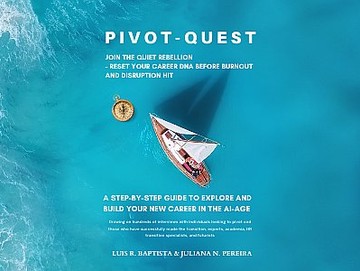
Luis and Juliana are the authors of Pivot‑Quest, a practical and deeply human guide for anyone standing at a crossroads in their career or life. Drawing from their own global careers, leadership experience, and firsthand pivots, they explore what it really takes to navigate change with clarity, courage, and intention. They join us here on the Publishizer Blog for a series of insightful conversations.
In this first conversation, we start at the beginning: the moment before the pivot begins.
Q: What originally inspired you to write Pivot-Quest, and why did this book feel necessary now?
A: We’ve both navigated multiple career pivots across industries, continents, and identities—from corporate roles in New York and Miami to reinvention in Europe and Latin America. And we kept noticing the same thing: people facing change felt profoundly alone—convinced everyone else had a plan while they were secretly drowning in self-doubt.
Here’s the thing nobody talks about: you can do all the “right” things—take the assessments, read the books, work with coaches—and still feel lost. Luis once sat in a temporary apartment with sixty-seven career assessments, every one promising clarity, none delivering it. Juliana navigated seven pivots across three continents, each time having to let go of who she thought she should be.
That shared experience is where Pivot-Quest was born. Not from having it figured out—but from living through the confusion and wishing someone had been honest with us about what the journey actually feels like.
Here’s what we discovered: that feeling of being stuck? It’s not a personal failing. It’s a shared human experience. Like realizing your relationship has run its course—not because anything is wrong, but because you’ve changed. Leaving something that once fit doesn’t mean you failed at choosing it.
The world of work is shifting faster than ever—across every economy, every industry, every generation. A 27-year-old with student debt wondering if they chose the wrong major. A 44-year-old who just got the layoff email after fifteen years of loyalty. Both are asking the same question: What now?
We wrote Pivot-Quest to be the companion we wished we’d had: warm, honest, and practical. No toxic positivity. No fairy tales. Just real guidance for the messy, terrifying, beautiful work of becoming who you’re meant to be in your next phase—whether you have six months or six years to figure it out.
Q: You use the word “pivot” very deliberately. What does a pivot mean to you, and how is it different from a traditional career change?
A: Think of a pivot like a snake shedding its skin. You’re not becoming someone new—you’re revealing who you’ve been growing into all along.
A traditional career change says: “Quit everything. Start over. Become someone else.”
A pivot says: “Use what you already have—your skills, your scars, your hard-won wisdom—and turn intentionally toward what fits now.”
Here’s the thing most people don’t realize: you’re not starting from zero. That degree you thought was a mistake? Those “random” side projects? The job you took just to pay rent? That’s not wasted time. That’s material. A pivot takes everything you’ve built and redirects it—like a basketball player planting one foot while turning to find a new angle.
Sometimes a pivot is dramatic and external—a complete industry change. Sometimes it’s quiet and internal—staying where you are but redefining what you do there. Sometimes it starts with nothing more than a whisper: “This isn’t it anymore.”
And sometimes it’s not a whisper at all—it’s a layoff email or a company restructure that forces the question overnight. Either way, a pivot is anchored in choice: even when circumstances push you, you decide what comes next.
You’re not running from something broken. You’re walking toward something truer. And that walk? It doesn’t require a destination. It just requires the courage to take the first step.
Q: Looking back on your own journeys, what personal experiences most shaped the perspective you bring to this book?
A: Before we wrote a single word, we interviewed dozens of people who wanted to pivot careers—across ages, industries, and countries. We expected to hear about strategy. What we heard instead broke us open.
A 35-year-old charity worker told us, “I’m so deep down in this hole now, I’m struggling to see that professional me again.” A 28-year-old in finance said, “I’ve traveled the path of least resistance my whole life... I just do enough to get to the finishing line.” A 37-year-old teacher confessed, “I sit in front of Google and I don’t even know what words to type to find what I want to do.”
A 32-year-old opera singer whispered, “I don’t have any control of my life... I feel like I was on a treadmill, and then there was no destination.” And a 44-year-old VP who’d just been laid off after fifteen years asked the question that haunted us: “Who am I, anyway, if I’m not working?”
These weren’t people who lacked talent or drive. They were accomplished professionals who had done everything “right” and still felt trapped. Some were drowning in student debt or had mortgages to pay. Some had golden handcuffs. Some had severance clocks ticking. All of them felt desperately, quietly alone.
That’s when we realized: this book couldn’t just be about frameworks and exercises. It had to start with the truth that feeling lost doesn’t mean you’re broken—it means you’re human.
For Juliana, this resonated deeply—seven pivots across three continents, each one requiring her to let go of who she thought she should be. For Luis, it was hearing his own confusion echoed back in every interview, regardless of the person’s age or income. We weren’t just researchers. We were fellow travelers.
We wrote Pivot-Quest because we’ve sat in that same fog—and we know there’s a way through.
Q: For someone reading this who feels stuck but unsure whether they are “allowed” to want something different, what would you want them to know?
A: You’re allowed.
That’s it. That’s the whole message. But let us say it again, because you probably need to hear it more than once:
Wanting more doesn’t make you ungrateful. Feeling stuck doesn’t mean you’ve failed. You’re not broken for questioning a path that once made sense.
Our research showed that 92% of people considering a career change lack confidence to take the leap. Ninety-two percent. You’re not uniquely lost—you’re in a silent majority, all wondering the same thing: Is it too late? Am I allowed?
And if you’re reading this because you just got laid off, or because your industry is collapsing, or because a severance clock is ticking—we see you. This book was written for you too. Not everyone has the luxury of slow exploration. Some pivots happen in months, not years. Pivot-Quest meets you where you are—whether you’re in crisis mode or quiet contemplation.
Think about the last time you wandered through a city you didn’t know. No itinerary. No fixed destination. Just... exploring. Turning down streets because they looked interesting. Stopping at a café because the light was right.
Something shifts when we frame change as exploration instead of escape. Suddenly, uncertainty isn’t danger—it’s possibility. A conversation that leads nowhere isn’t a waste; it’s data. A path that doesn’t pan out isn’t failure—it happened for you, not to you. It taught you something. It became part of your story.
You don’t need all the answers to begin. You just need permission to move.
And you don’t have to move alone. We’re building a community of explorers—people in the middle of their pivot and serial pivoters who’ve been through it and want to light the path for others. People who started over at 27 with student loans. People who reinvented themselves at 50 after a layoff. Whether you’re looking for direction or ready to offer it, you belong here.
Start with curiosity. Start with honesty. Start with yourself.
Luis R. Baptista and Juliana N. Pereira are the authors of Pivot-Quest: a guide for professionals who sense there’s more inside them but fear the cost of finding it. Between them, they’ve navigated careers across the Americas and Europe—and interviewed hundreds of people doing the same.