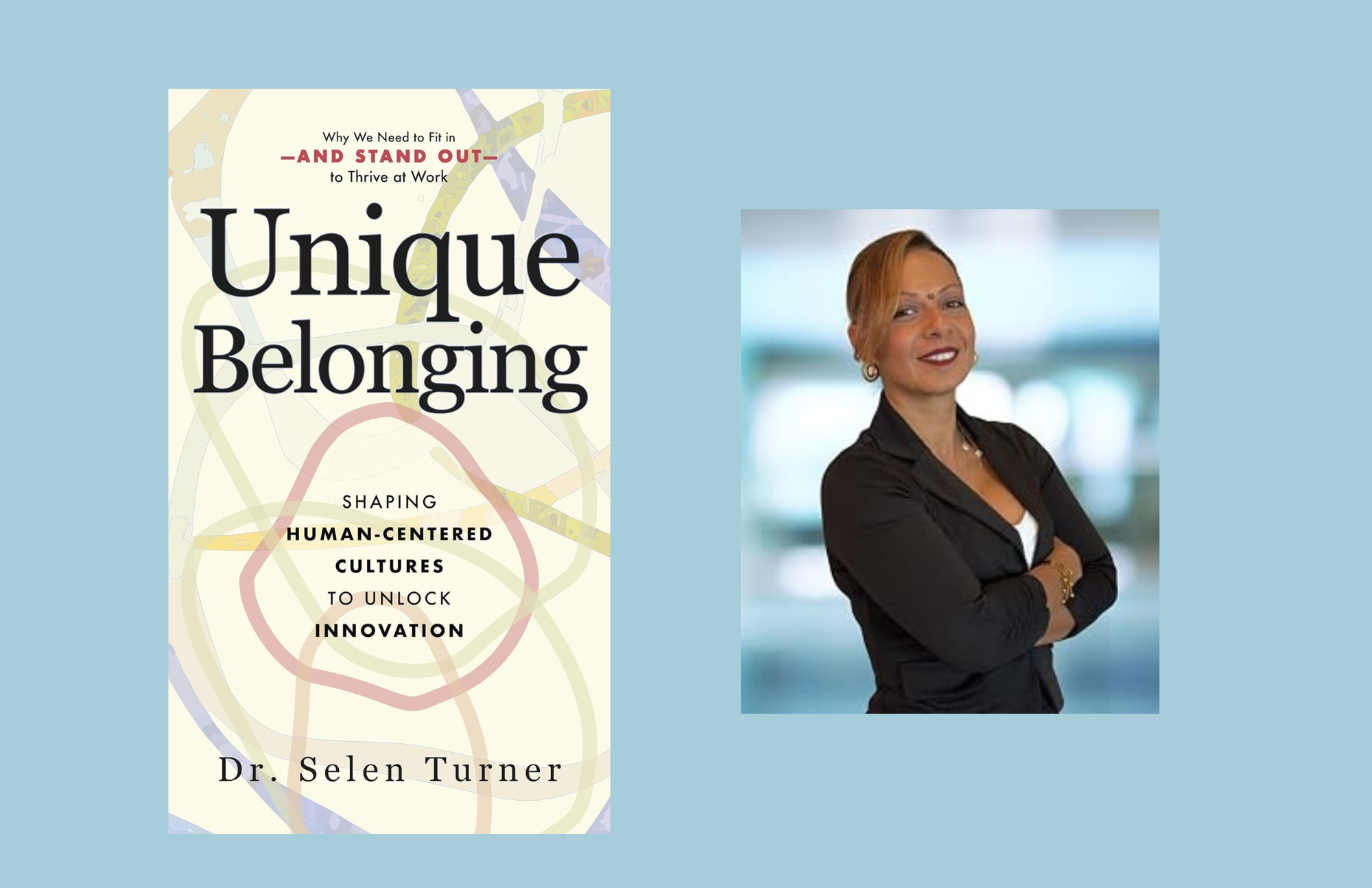
Unique Beloning: Shaping Human-Centered Cultures to Unlock Innovation (Red Thread Books)
By Selen Turner, PhD.
I've wanted to be an author for a long time.
Writing a book wasn't something I stumbled into. In many ways, it was part of a larger vision I had for the next chapter of my life. After more than 20 years working inside organizations, I envisioned a career that would allow me to share what I had learned through teaching, consulting, research, and writing. Earning a PhD, teaching, advising leaders, consulting, and becoming an author were all connected pieces of that vision.
When I started my doctoral program, I was thoughtful about choosing a dissertation topic. One of my professors encouraged me not to think about changing the world all at once through a dissertation, but instead to see the dissertation as one step toward making a difference. That perspective helped me focus on finding a topic that would remain relevant and meaningful long after graduation.
At the time, what fascinated me most was innovation.
Throughout my career, I was fortunate to be placed in roles where I could lead innovation, transform HR processes, shape leadership principles, and influence organizational cultures. I loved that work. I learned firsthand what it means to lead change and how difficult it can be to move people, systems, and organizations in a new direction.
At the same time, I became increasingly curious about what enables people to contribute their best ideas. Why do some environments encourage people to speak up, challenge thinking, and continuously improve, while others seem to hold people back?
As I explored the literature, I came across Dr. Marilynn Brewer's Optimal Distinctiveness Theory and later Dr. Lynn Shore's research on inclusion and belonging. Their work introduced an idea that immediately caught my attention: people have two important needs, the need to belong and the need to be recognized for what makes them unique.
The more I explored those concepts, the more connections I began to see between belonging, uniqueness, and innovation. If people feel accepted and connected while also feeling valued for what makes them different, would they be more willing to share ideas, challenge assumptions, and help organizations innovate?
That question eventually became the focus of my dissertation and later the foundation of Unique Belonging.
What made the topic much more than an academic exercise, however, were the people.
During my dissertation research, I interviewed women about their workplace experiences. They shared stories about opportunities they received, opportunities they missed, times they felt valued, and times they felt invisible. Some stories were uplifting. Others were difficult to hear. Many reveal the tension people experience when they feel they must choose between fitting in and being themselves.
Their stories made the research real.
Listening to those conversations, I felt a growing sense of responsibility. As an organizational psychologist, HR leader, and leadership advisor, I have the opportunity to influence leaders, executives, HR systems, and organizational cultures that impact thousands of people around the world. It felt like I had been entrusted with stories that mattered. I couldn't imagine simply documenting the findings, publishing a dissertation, and moving on.
But the topic was personal for me as well.
Before becoming a consultant, I spent more than 20 years working inside organizations. During that time, I experienced many of the same tensions I was studying. I've always been someone who looks for ways to improve things. Continuous improvement is part of who I am. Because of that, I often saw opportunities, had ideas, or noticed things that could be done differently.
Sometimes those ideas were welcomed. Other times they weren't.
There were moments when I felt frustrated because I didn't feel heard. There were times when I wasn't sure it was safe to challenge an idea or share a different perspective. And there were moments when staying quiet felt easier than risking being seen as difficult, disruptive, or out of step with the group.
Over the years, I realized that many people experience the same dilemma. They want to contribute, but they are also trying to protect their relationships, credibility, and sense of belonging.
As my research evolved, I found myself increasingly interested not only in the role of leaders and organizations, but also in the role of the individual.
One of the biggest insights for me was realizing how much influence we each have over our own experience. While leaders and organizations play an important role in creating environments where people can thrive, individuals also shape their own experience through the choices they make, the risks they take, and the voices they choose to share.
That was a significant realization for me because I had experienced many of these tensions myself. As I reflected on my own career, I began to recognize that sometimes the barriers were external, but sometimes I was getting in my own way. Fear, self-doubt, assumptions, or the desire to fit in can prevent us from contributing what we know, see, and believe.
That insight became one of the foundations of the book.
Creating better workplaces is not solely the responsibility of leaders or organizations. We all have a role to play.
The encouragement I received throughout my doctoral journey reinforced that belief. My dissertation committee loved the stories, participant quotes, and practical implications of the research. The people who helped me recruit participants connected with the purpose behind the work and often asked, "What's next?"
Anyone who knows me knows that's a dangerous question to ask.
If I see an opportunity to make a positive difference and someone gives me a little encouragement, I'm likely to run with it.
So, I did.
Of course, writing the book turned out to be its own learning experience.
One of my biggest surprises was simply realizing that I had written a book. Another was the number of decisions involved in publishing. I expected writing to be the hard part. Instead, I found myself making decisions about trademarks, chapter names, graphics, design elements, formatting, and countless details I had never considered before.
The most unexpected lesson, however, was how much the book challenged me personally.
Throughout Unique Belonging, I encourage people to stay in their power, use their voice, and challenge assumptions when something doesn't feel right. As a consultant, there are many moments when I have to do exactly that. My work often requires me to ask difficult questions, challenge long-held beliefs, and help leaders see situations from a different perspective.
As I was writing, I often found myself thinking, If you're encouraging others to do this, you need to do it too.
More than once, I wrote a chapter and then intentionally practiced those ideas in my own life and work. The book became more than a writing project. It became an opportunity to live the message.
What excites me most about Unique Belonging today is that I didn't have to choose between writing for individuals, leaders, or organizations.
Thanks to the guidance of my publisher and book coach, the book is organized into three parts because that's how I see culture. Individuals shape culture. Leaders amplify culture. Organizations enable culture. They're interconnected, and lasting change happens when all three play their part.
My hope is that every reader finds something meaningful in the book. Whether you're an individual contributor, a leader, an HR professional, or an executive, there is a place for you in this conversation. That's why I've included assessments, reflection questions, developmental tools, and practical actions to help readers apply the ideas in their own lives and organizations, some in the book and some tools will be available on my website: www.theturnerconnection.com.
At its core, Unique Belonging is built on a simple belief: people shouldn't have to choose between belonging and being themselves.
When people feel both connected and valued for what makes them different, they contribute more, grow more, innovate more, and thrive more.
That's the conversation I hope this book continues long after the last page is read.